

Why Data Is Not the Same as Understanding
This is the second in a series of reflections exploring capability, understanding, purpose, context and the human role in an age of AI.
We Have Never Had More Information
We live in an age of abundance.
More data.
More dashboards.
More reports.
More analytics.
More notifications.
More insights.
And increasingly, more AI-generated summaries of all of the above.
Yet despite this explosion of information, many organisations continue to struggle with decision-making.
Communities still face complex challenges.
Public services still wrestle with difficult trade-offs.
Leaders still make mistakes.
It is tempting to assume that the answer is more information.
But what if that isn’t the problem?
What if the real challenge is understanding?
King Lear’s Tragedy
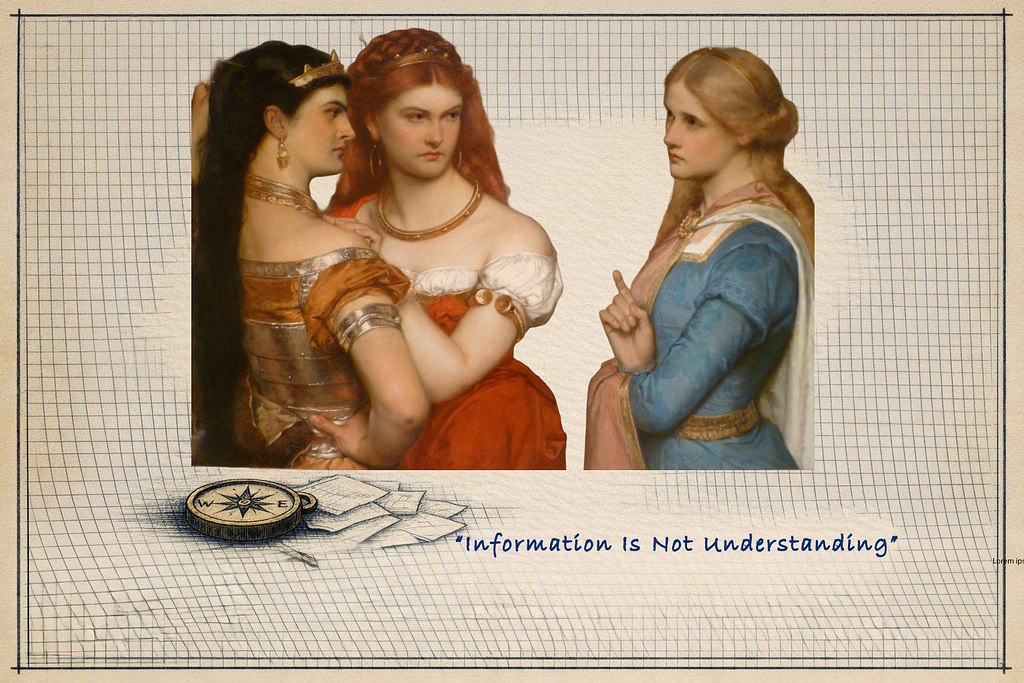
In Shakespeare’s King Lear, the ageing king decides to divide his kingdom between his three daughters.
Before doing so, he asks each to declare how much they love him.
Two daughters provide extravagant declarations.
One daughter, Cordelia, refuses to flatter him.
Lear mistakes performance for truth.
He rewards those who tell him what he wants to hear and rejects the person who is speaking honestly.
The tragedy that follows is not caused by a lack of information.
Lear is surrounded by information.
Advice.
Evidence.
Opinions.
Declarations.
Warnings.
The tragedy emerges because he misunderstands what matters.
A Reflection
Having information and understanding information are not the same thing.
And understanding does not automatically lead to wisdom.
Data Is Rarely the Problem
One lesson I have learned repeatedly through work spanning public services, health data, communities and information management is that the problem is seldom a lack of data.
In many cases:
- the data already exists,
- the reports already exist,
- the systems already exist,
- the evidence already exists.
Yet people still struggle to develop a common understanding of what is actually happening.
Different teams see different parts of the picture.
Different organisations use different language.
Different systems describe the same issue in different ways.
Everyone may be looking at the same reality.
Yet drawing different conclusions.
A Lesson From Public Services
One of the most valuable lessons I have encountered through work involving children, families and communities was surprisingly simple.
The important question was not:
What data do we hold?
It was:
What matters?
That sounds subtle.
But it changes everything.
Instead of beginning with systems and datasets, the conversation begins with people.
Children.
Families.
Experiences.
Relationships.
Outcomes.
Only then does data become useful.
Because data gains meaning through context.
Context Changes Everything
Consider a simple statement:
Household income: £18,000
Useful information.
But incomplete.
Now add context.
A family of four.
A rural location.
Limited public transport.
Long travel distances.
High childcare costs.
Seasonal employment.
Restricted access to services.
The meaning changes entirely.
The number is the same.
The understanding is different.
Data tells us what.
Context helps us understand why.
Understanding helps us decide what to do next.
People, Organisations, Places and Context
Increasingly I find myself thinking about four interconnected elements.
People
Individuals.
Families.
Communities.
Citizens.
Practitioners.
Organisations
Councils.
Health Boards.
Charities.
Businesses.
Government agencies.
Places
Neighbourhoods.
Towns.
Cities.
Rural communities.
Regions.
Context
Relationships.
History.
Needs.
Services.
Constraints.
Opportunities.
Understanding emerges from the interaction between all four.
Remove one and the picture becomes distorted.
Information Without Understanding
King Lear’s mistake feels surprisingly modern.
It wasn’t a lack of information that caused the problem.
It was the inability to distinguish signal from noise.
Truth from performance.
Meaning from appearance.
Today’s organisations face similar risks.
We can become obsessed with:
- metrics,
- dashboards,
- reports,
- indicators,
- AI-generated summaries,
while forgetting to ask a more fundamental question:
Do we truly understand what we are looking at?
A Question Worth Holding
In an age when information is increasingly abundant, does understanding become more valuable?
Understanding Is a Shared Activity
Understanding rarely happens in isolation.
It emerges through conversation.
Through challenge.
Through different perspectives.
Through experience.
This is particularly true when problems cross organisational boundaries.
Health.
Poverty.
Housing.
Education.
Community wellbeing.
No single organisation owns the whole picture.
No single dataset explains it.
No single perspective resolves it.
Understanding becomes something we build together.
Looking Ahead
If The Wizard of Oz warns us not to mistake capability for wisdom…
then King Lear reminds us not to mistake information for understanding.
But understanding alone is not enough.
Another question remains.
Even if we understand a problem perfectly:
Why are we trying to solve it?
That question takes us to another traveller.
Jonathan Swift’s Gulliver’s Travels.
And the strange inventors of the Academy of Lagado.
Final Reflection
Perhaps the challenge of the AI age is not producing more information.
Perhaps it is developing better understanding.
Because without understanding, even abundant information can still lead us astray.
Next in the series:
Gulliver’s Travels and the Purpose of Innovation
Are We Solving Important Problems or Simply Building Clever Things?
About the author
David Eccles is a co-founder of Wallscope, based in Edinburgh, Scotland. He writes about AI, organisational knowledge, interoperability, shared context and public-sector transformation, exploring how organisations can turn fragmented information into actionable knowledge.
🌐 https://wallscope.co.uk
🔗 https://www.linkedin.com/in/davidecclesedinburgh/

King Lear and the Limits of Information was originally published in Wallscope on Medium, where people are continuing the conversation by highlighting and responding to this story.