

Human Purpose in an Age of Increasingly Capable AI
The Question I Keep Returning To
After all the discussions about AI, agents, automation and innovation, I find myself returning to a much simpler question.
Not:
What will AI become?
But:
What will we become?
Every week brings new examples of systems performing tasks that previously required significant human effort.
Writing.
Research.
Analysis.
Programming.
Planning.
Decision support.
Creative work.
The list continues to grow.
The question is no longer whether AI will become increasingly capable.
Increasingly, it already is.
The question is what role remains for us.
The Wrong Question
Much of the public conversation seems to focus on replacement.
Will AI replace jobs?
Will AI replace professions?
Will AI replace expertise?
These are understandable concerns.
But perhaps they are the wrong questions.
Technology has always changed the nature of work.
The more interesting question is often:
What becomes more valuable as technology evolves?
Not what disappears.
What emerges.
Humans Have Always Adapted
When calculators appeared, mathematics did not disappear.
When spreadsheets arrived, finance did not disappear.
When search engines emerged, knowledge did not disappear.
The nature of expertise changed.
Each time, humans moved further from routine processing and closer towards interpretation, judgement and application.
Perhaps AI represents a similar shift.
Not the end of human contribution.
But a change in where that contribution creates value.
A Question Worth Holding
If machines increasingly generate answers, what should humans become better at?
Asking Better Questions
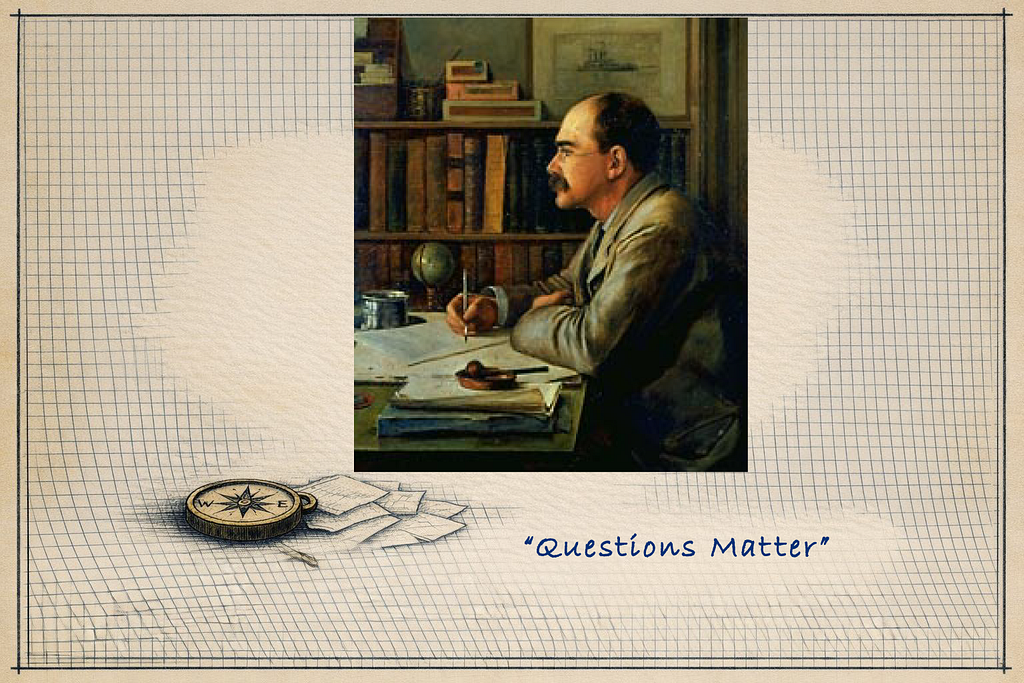
Rudyard Kipling wrote:
I keep six honest serving-men
(They taught me all I knew);
Their names are What and Why and When
And How and Where and Who.
Increasingly I wonder whether our most valuable capability may lie in asking better questions.
Questions about:
- purpose,
- outcomes,
- assumptions,
- consequences,
- trade-offs,
- values.
Questions that no model can answer independently because they depend upon human priorities.
The quality of our future systems may depend less on the sophistication of our answers and more on the quality of our questions.
We Have Been Here Before
Looking back across my own experience, I am struck by how often the same challenge has appeared in different forms.
Publishing.
Communications.
Brand development.
Marketing.
Podcasts.
Health data.
Public services.
Digital transformation.
Information management.
At first glance these seem like different disciplines.
Yet each has involved the same underlying task:
Helping people make sense of complexity.
Sometimes through stories.
Sometimes through conversations.
Sometimes through data.
Sometimes through systems.
The tools differ.
The challenge remains remarkably similar.
Stories Matter
One lesson from communications and storytelling is that people rarely make sense of the world through information alone.
Facts matter.
Evidence matters.
Data matters.
But understanding often emerges through narrative.
Stories provide context.
Stories connect events.
Stories help us recognise relationships.
Stories help us understand consequences.
This may be one reason why literature continues to offer useful insights in an age of AI.
The Wizard of Oz.
King Lear.
Gulliver’s Travels.
They are not data sets.
They are ways of thinking.
Ways of understanding.
Ways of asking questions.
Human in the Loop
We often talk about keeping humans “in the loop”.
I sometimes wonder if that phrase understates the issue.
Humans do not simply supervise the system.
Humans provide many of the things that give the system meaning.
Purpose.
Context.
Judgement.
Values.
Accountability.
Responsibility.
The challenge is not merely ensuring that a human approves a decision.
The challenge is ensuring that human understanding remains connected to action.
Context as a Human Strength
One of the most important lessons I have learned through work involving communities, health, public services and organisations is that context changes everything.
A statistic can be accurate and still be misleading.
A recommendation can be logical and still be inappropriate.
A decision can be efficient and still be wrong.
Context explains why.
Humans remain remarkably good at:
- recognising nuance,
- understanding relationships,
- navigating ambiguity,
- appreciating history,
- interpreting circumstances.
These capabilities become more important, not less, as systems become more capable.
Meaning Matters
Artificial Intelligence can identify patterns.
It can recommend actions.
It can generate convincing outputs.
But it does not determine what matters.
Humans do.
We decide:
- what outcomes are desirable,
- what success looks like,
- what costs are acceptable,
- what risks we are willing to take,
- what responsibilities we hold towards one another.
These are not technical questions.
They are human questions.
A Different Kind of Expertise
Perhaps the future values a different kind of expertise.
Not expertise built around possessing information.
But expertise built around:
- making sense of complexity,
- bringing different perspectives together,
- creating shared understanding,
- connecting knowledge to action,
- helping others ask better questions.
The challenge may not be competing with increasingly capable systems.
The challenge may be becoming better stewards of meaning.
Looking Ahead
The first question in this series came from The Wizard of Oz:
What lies behind the curtain?
The second came from King Lear:
Do we understand what matters?
The third came from Gulliver’s Travels:
Why are we doing this?
And perhaps they all lead here.
Not to a question about AI.
But to a question about ourselves.
Final Reflection
As intelligence and agency become increasingly abundant, I find myself asking:
What should I learn?
What responsibilities should I hold?
What role should I play?
Perhaps the same questions apply to all of us.
Because the future may not belong to those who merely know the answers.
It may belong to those who ask the questions that matter.
Next in the series:
People, Organisations, Places and Context
Building Shared Understanding in a Complex World
About the author
David Eccles is a co-founder of Wallscope, based in Edinburgh, Scotland. He writes about AI, organisational knowledge, interoperability, shared context and public-sector transformation, exploring how organisations can turn fragmented information into actionable knowledge.
🌐 https://wallscope.co.uk
🔗 https://www.linkedin.com/in/davidecclesedinburgh/

What Is My Role? was originally published in Wallscope on Medium, where people are continuing the conversation by highlighting and responding to this story.