What Is My Role?

Human Purpose in an Age of Increasingly Capable AI
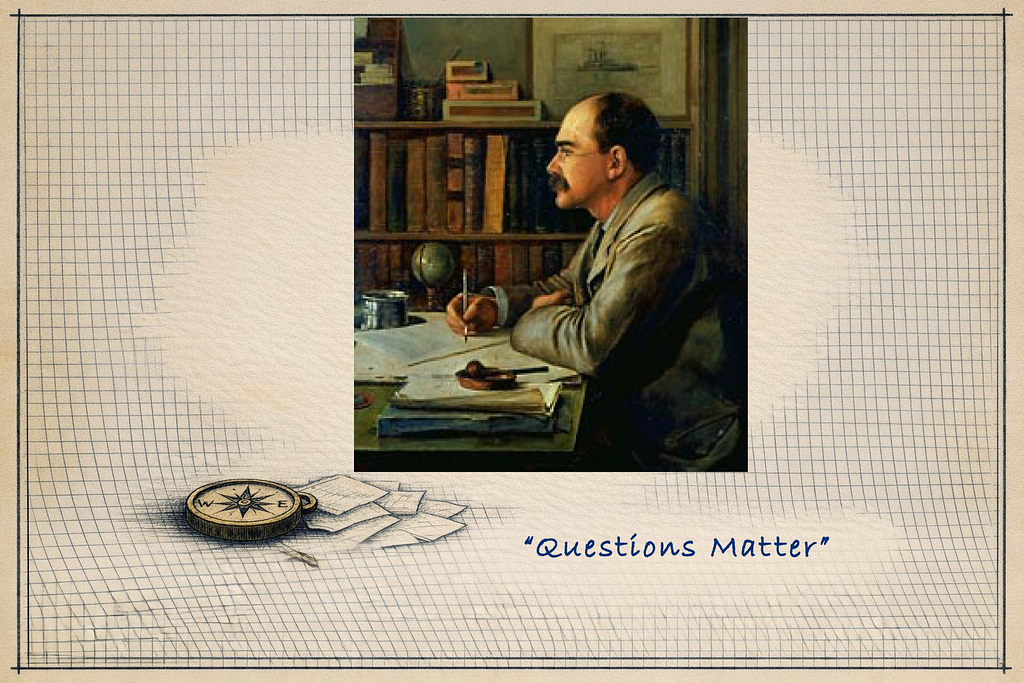
Questions matter

The Question I Keep Returning To

After all the discussions about AI, agents, automation and innovation, I find myself returning to a much simpler question.

Not:

What will AI become?

But:

What will we become?

Every week brings new examples of systems performing tasks that previously required significant human effort.

Writing.

Research.

Analysis.

Programming.

Planning.

Decision support.

Creative work.

The list continues to grow.

The question is no longer whether AI will become increasingly capable.

Increasingly, it already is.

The question is what role remains for us.

The Wrong Question

Much of the public conversation seems to focus on replacement.

Will AI replace jobs?

Will AI replace professions?

Will AI replace expertise?

These are understandable concerns.

But perhaps they are the wrong questions.

Technology has always changed the nature of work.

The more interesting question is often:

What becomes more valuable as technology evolves?

Not what disappears.

What emerges.

Humans Have Always Adapted

When calculators appeared, mathematics did not disappear.

When spreadsheets arrived, finance did not disappear.

When search engines emerged, knowledge did not disappear.

The nature of expertise changed.

Each time, humans moved further from routine processing and closer towards interpretation, judgement and application.

Perhaps AI represents a similar shift.

Not the end of human contribution.

But a change in where that contribution creates value.

A Question Worth Holding

If machines increasingly generate answers, what should humans become better at?

Asking Better Questions

Rudyard Kipling wrote:

I keep six honest serving-men
(They taught me all I knew);
Their names are What and Why and When
And How and Where and Who.

Increasingly I wonder whether our most valuable capability may lie in asking better questions.

Questions about:

  • purpose,
  • outcomes,
  • assumptions,
  • consequences,
  • trade-offs,
  • values.

Questions that no model can answer independently because they depend upon human priorities.

The quality of our future systems may depend less on the sophistication of our answers and more on the quality of our questions.

We Have Been Here Before

Looking back across my own experience, I am struck by how often the same challenge has appeared in different forms.

Publishing.

Communications.

Brand development.

Marketing.

Podcasts.

Health data.

Public services.

Digital transformation.

Information management.

At first glance these seem like different disciplines.

Yet each has involved the same underlying task:

Helping people make sense of complexity.

Sometimes through stories.

Sometimes through conversations.

Sometimes through data.

Sometimes through systems.

The tools differ.

The challenge remains remarkably similar.

Stories Matter

One lesson from communications and storytelling is that people rarely make sense of the world through information alone.

Facts matter.

Evidence matters.

Data matters.

But understanding often emerges through narrative.

Stories provide context.

Stories connect events.

Stories help us recognise relationships.

Stories help us understand consequences.

This may be one reason why literature continues to offer useful insights in an age of AI.

The Wizard of Oz.

King Lear.

Gulliver’s Travels.

They are not data sets.

They are ways of thinking.

Ways of understanding.

Ways of asking questions.

Human in the Loop

We often talk about keeping humans “in the loop”.

I sometimes wonder if that phrase understates the issue.

Humans do not simply supervise the system.

Humans provide many of the things that give the system meaning.

Purpose.

Context.

Judgement.

Values.

Accountability.

Responsibility.

The challenge is not merely ensuring that a human approves a decision.

The challenge is ensuring that human understanding remains connected to action.

Context as a Human Strength

One of the most important lessons I have learned through work involving communities, health, public services and organisations is that context changes everything.

A statistic can be accurate and still be misleading.

A recommendation can be logical and still be inappropriate.

A decision can be efficient and still be wrong.

Context explains why.

Humans remain remarkably good at:

  • recognising nuance,
  • understanding relationships,
  • navigating ambiguity,
  • appreciating history,
  • interpreting circumstances.

These capabilities become more important, not less, as systems become more capable.

Meaning Matters

Artificial Intelligence can identify patterns.

It can recommend actions.

It can generate convincing outputs.

But it does not determine what matters.

Humans do.

We decide:

  • what outcomes are desirable,
  • what success looks like,
  • what costs are acceptable,
  • what risks we are willing to take,
  • what responsibilities we hold towards one another.

These are not technical questions.

They are human questions.

A Different Kind of Expertise

Perhaps the future values a different kind of expertise.

Not expertise built around possessing information.

But expertise built around:

  • making sense of complexity,
  • bringing different perspectives together,
  • creating shared understanding,
  • connecting knowledge to action,
  • helping others ask better questions.

The challenge may not be competing with increasingly capable systems.

The challenge may be becoming better stewards of meaning.

Looking Ahead

The first question in this series came from The Wizard of Oz:

What lies behind the curtain?

The second came from King Lear:

Do we understand what matters?

The third came from Gulliver’s Travels:

Why are we doing this?

And perhaps they all lead here.

Not to a question about AI.

But to a question about ourselves.

Final Reflection

As intelligence and agency become increasingly abundant, I find myself asking:

What should I learn?

What responsibilities should I hold?

What role should I play?

Perhaps the same questions apply to all of us.

Because the future may not belong to those who merely know the answers.

It may belong to those who ask the questions that matter.

Next in the series:

People, Organisations, Places and Context

Building Shared Understanding in a Complex World

About the author

David Eccles is a co-founder of Wallscope, based in Edinburgh, Scotland. He writes about AI, organisational knowledge, interoperability, shared context and public-sector transformation, exploring how organisations can turn fragmented information into actionable knowledge.

🌐 https://wallscope.co.uk
🔗
https://www.linkedin.com/in/davidecclesedinburgh/


What Is My Role? was originally published in Wallscope on Medium, where people are continuing the conversation by highlighting and responding to this story.

King Lear and the Limits of Information

Why Data Is Not the Same as Understanding

This is the second in a series of reflections exploring capability, understanding, purpose, context and the human role in an age of AI.

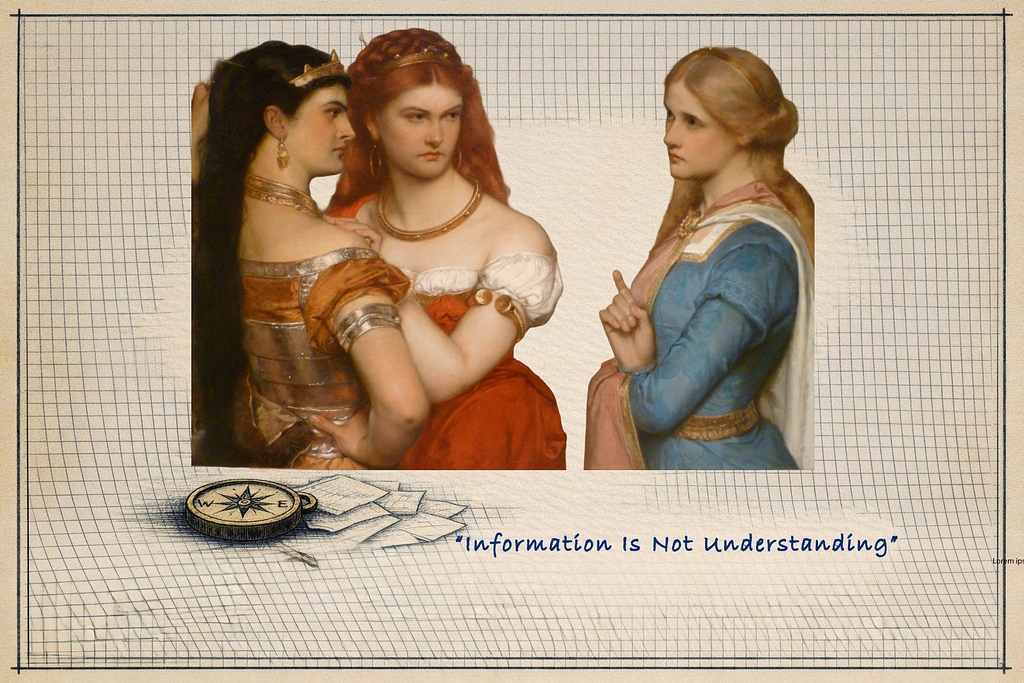
Vintage illustration of three figures beside a compass and scattered papers on a graph-paper background, with the text “Information Is Not Understanding”.

We Have Never Had More Information

We live in an age of abundance.

More data.

More dashboards.

More reports.

More analytics.

More notifications.

More insights.

And increasingly, more AI-generated summaries of all of the above.

Yet despite this explosion of information, many organisations continue to struggle with decision-making.

Communities still face complex challenges.

Public services still wrestle with difficult trade-offs.

Leaders still make mistakes.

It is tempting to assume that the answer is more information.

But what if that isn’t the problem?

What if the real challenge is understanding?

King Lear’s Tragedy

In Shakespeare’s King Lear, the ageing king decides to divide his kingdom between his three daughters.

Before doing so, he asks each to declare how much they love him.

Two daughters provide extravagant declarations.

One daughter, Cordelia, refuses to flatter him.

Lear mistakes performance for truth.

He rewards those who tell him what he wants to hear and rejects the person who is speaking honestly.

The tragedy that follows is not caused by a lack of information.

Lear is surrounded by information.

Advice.

Evidence.

Opinions.

Declarations.

Warnings.

The tragedy emerges because he misunderstands what matters.

A Reflection

Having information and understanding information are not the same thing.

And understanding does not automatically lead to wisdom.

Data Is Rarely the Problem

One lesson I have learned repeatedly through work spanning public services, health data, communities and information management is that the problem is seldom a lack of data.

In many cases:

  • the data already exists,
  • the reports already exist,
  • the systems already exist,
  • the evidence already exists.

Yet people still struggle to develop a common understanding of what is actually happening.

Different teams see different parts of the picture.

Different organisations use different language.

Different systems describe the same issue in different ways.

Everyone may be looking at the same reality.

Yet drawing different conclusions.

A Lesson From Public Services

One of the most valuable lessons I have encountered through work involving children, families and communities was surprisingly simple.

The important question was not:

What data do we hold?

It was:

What matters?

That sounds subtle.

But it changes everything.

Instead of beginning with systems and datasets, the conversation begins with people.

Children.

Families.

Experiences.

Relationships.

Outcomes.

Only then does data become useful.

Because data gains meaning through context.

Context Changes Everything

Consider a simple statement:

Household income: £18,000

Useful information.

But incomplete.

Now add context.

A family of four.

A rural location.

Limited public transport.

Long travel distances.

High childcare costs.

Seasonal employment.

Restricted access to services.

The meaning changes entirely.

The number is the same.

The understanding is different.

Data tells us what.

Context helps us understand why.

Understanding helps us decide what to do next.

People, Organisations, Places and Context

Increasingly I find myself thinking about four interconnected elements.

People

Individuals.

Families.

Communities.

Citizens.

Practitioners.

Organisations

Councils.

Health Boards.

Charities.

Businesses.

Government agencies.

Places

Neighbourhoods.

Towns.

Cities.

Rural communities.

Regions.

Context

Relationships.

History.

Needs.

Services.

Constraints.

Opportunities.

Understanding emerges from the interaction between all four.

Remove one and the picture becomes distorted.

Information Without Understanding

King Lear’s mistake feels surprisingly modern.

It wasn’t a lack of information that caused the problem.

It was the inability to distinguish signal from noise.

Truth from performance.

Meaning from appearance.

Today’s organisations face similar risks.

We can become obsessed with:

  • metrics,
  • dashboards,
  • reports,
  • indicators,
  • AI-generated summaries,

while forgetting to ask a more fundamental question:

Do we truly understand what we are looking at?

A Question Worth Holding

In an age when information is increasingly abundant, does understanding become more valuable?

Understanding Is a Shared Activity

Understanding rarely happens in isolation.

It emerges through conversation.

Through challenge.

Through different perspectives.

Through experience.

This is particularly true when problems cross organisational boundaries.

Health.

Poverty.

Housing.

Education.

Community wellbeing.

No single organisation owns the whole picture.

No single dataset explains it.

No single perspective resolves it.

Understanding becomes something we build together.

Looking Ahead

If The Wizard of Oz warns us not to mistake capability for wisdom…

then King Lear reminds us not to mistake information for understanding.

But understanding alone is not enough.

Another question remains.

Even if we understand a problem perfectly:

Why are we trying to solve it?

That question takes us to another traveller.

Jonathan Swift’s Gulliver’s Travels.

And the strange inventors of the Academy of Lagado.

Final Reflection

Perhaps the challenge of the AI age is not producing more information.

Perhaps it is developing better understanding.

Because without understanding, even abundant information can still lead us astray.

Next in the series:

Gulliver’s Travels and the Purpose of Innovation

Are We Solving Important Problems or Simply Building Clever Things?

About the author

David Eccles is a co-founder of Wallscope, based in Edinburgh, Scotland. He writes about AI, organisational knowledge, interoperability, shared context and public-sector transformation, exploring how organisations can turn fragmented information into actionable knowledge.

🌐 https://wallscope.co.uk
🔗
https://www.linkedin.com/in/davidecclesedinburgh/


King Lear and the Limits of Information was originally published in Wallscope on Medium, where people are continuing the conversation by highlighting and responding to this story.

The Wizard Behind the Curtain

What The Wizard of Oz Can Teach Us About AI, Capability and the Questions We Should Still Be Asking Ourselves

This is the first in a series of reflections exploring capability, understanding, purpose, context and the human role in an age of AI.

Three Stories Have Been On My Mind Recently

Three stories from very different times.

The Wizard of Oz.

King Lear.

Gulliver’s Travels.

At first glance, they have little in common.

Yet each explores a question that feels increasingly relevant as we enter an age of Artificial Intelligence.

The Wizard of Oz asks:

What lies behind the curtain?

King Lear asks:

Do we truly understand what matters?

Gulliver’s Travels asks:

Why are we doing this in the first place?

This article begins with the first of these questions.

The Wizard of Oz: Looking Behind the Curtain

In The Wizard of Oz, Dorothy and her companions travel in search of wisdom, courage and purpose.

The mysterious Wizard appears all-powerful.

Only later do they discover a figure operating machinery behind a curtain.

Smoke.

Lights.

Effects.

Amplification.

The Wizard is not what he appears to be.

And yet, despite this revelation, the story is not really about deception.

It is about something much more interesting.

The qualities the travellers were searching for did not originate with the Wizard at all.

The Scarecrow sought intelligence.

The Tin Man sought compassion.

The Lion sought courage.

Dorothy sought her way home.

What they eventually discovered was that these qualities were not hidden inside a machine.

They emerged through experience, relationships and understanding.

The Machinery Behind Today’s Curtain

Much of today’s conversation about AI feels strangely familiar.

We are fascinated by:

  • larger models,
  • increasingly capable agents,
  • bigger context windows,
  • more powerful computing infrastructure,
  • automation at unprecedented scale.

And rightly so.

These are remarkable achievements.

Yet I sometimes wonder whether we risk becoming too fascinated by the machinery behind the curtain.

The question dominating many discussions is:

What can these systems do?

A fair question.

But perhaps not the most important one.

A Question Worth Holding

If increasingly capable systems can generate answers, recommendations and actions:

What questions should humans be asking?

We Were Told Data Was the New Oil

For years we were told:

Data is the new oil.

It’s a useful metaphor.

But perhaps not for the reasons people intended.

Oil has no intrinsic purpose.

Its value comes from what we choose to do with it.

We can use it to power transport.

Manufacture plastics.

Heat buildings.

Every choice produces different outcomes and different consequences.

Some benefits remain visible.

Some costs become externalised and borne elsewhere.

The important questions are therefore not about the oil itself.

They are about purpose.

What are we trying to achieve?

Who benefits?

Who bears the costs?

What consequences are we willing to accept?

The same may increasingly be true of AI.

More capability does not automatically create better outcomes.

It simply increases our capacity to act.

Artificial Intelligence Is a Curious Phrase

The phrase itself has always intrigued me.

Artificial Intelligence suggests that intelligence somehow originates within the machine.

Yet much of what today’s systems know comes from humans.

Human language.

Human experience.

Human institutions.

Human history.

Human knowledge.

Human conversations.

Human values.

The infrastructure is becoming increasingly capable.

The ability to process information is no longer the major constraint it once was.

But greater capability does not automatically create greater understanding.

And it certainly does not create wisdom.

Capability Is Not Wisdom

This, perhaps, is the lesson I take from The Wizard of Oz.

The Wizard represents capability.

Modern AI is becoming increasingly capable.

But capability alone cannot tell us:

  • what matters,
  • who matters,
  • which outcomes should be prioritised,
  • what constitutes success,
  • what consequences should concern us.

These remain deeply human questions.

The story reminds us that the answers may not be hidden behind the curtain at all.

They may lie in our ability to ask better questions.

Looking Ahead

The Wizard of Oz leaves us with a useful challenge.

As AI systems become increasingly capable, are we becoming more fascinated with what machines can do than with what humans ought to do?

That question leads naturally to another story.

Because if The Wizard of Oz asks:

What lies behind the curtain?

Then Shakespeare’s King Lear asks something even more uncomfortable:

How can we be surrounded by information and still fail to understand what matters?

That is where I will go next.

Final Reflection

Perhaps the greatest challenge of the AI age is not intelligence.

Perhaps it is understanding.

And perhaps the first step is learning to look beyond the machinery behind the curtain.

Next in the series:

King Lear and the Limits of Information

Why Data Is Not the Same as Understanding

About the author

David Eccles is a co-founder of Wallscope, based in Edinburgh, Scotland. He writes about AI, organisational knowledge, interoperability, shared context and public-sector transformation, exploring how organisations can turn fragmented information into actionable knowledge.

🌐 https://wallscope.co.uk
🔗
https://www.linkedin.com/in/davidecclesedinburgh/


The Wizard Behind the Curtain was originally published in Wallscope on Medium, where people are continuing the conversation by highlighting and responding to this story.
Latest Insights

/ Home » Wallscope » Page 3

Latest Insights on Data, Clarity and Collaboration in Scotland

Wallscope shares insights, updates and real-world examples from our work with Scotland’s public sector, SMEs and creative organisations, exploring how better use of data supports informed decision-making, collaboration and positive outcomes.

  • Closing the Evidence Gap in AI Governance
    AI governance frameworks define how decisions should be made, but can organisations demonstrate what actually happened when those decisions were reached? This article examines why evidence, not just governance, is critical for accountable and trustworthy AI.
  • Preserving Human Judgement with VeriNote: A Practical Example
    How can organisations ensure that human judgement remains visible when AI is involved in decision-making? This practical case study shows how VeriNote helps capture the reasoning behind decisions, creating a clear and auditable record that links evidence, interpretation and outcomes.
  • A Practical Approach to Sustainable AI for the Public Sector
    Rising energy demands, cloud costs and governance expectations are reshaping how public bodies approach AI. Learn how VeriNote helps organisations preserve context, improve decision-making and create the conditions for more efficient and sustainable use of AI.
  • Preserving Human Judgement 
    The EU AI Act will require organisations to prove that human oversight of high‑risk AI was genuinely informed and effective. This article explains why traditional “human in the loop” approaches fall short, why preserving decision context now matters, and how VeriNote helps organisations demonstrate real human judgement as AI systems become more autonomous.
  • Strengthening Capability
    Organisations aren’t limited by data or tools — they’re limited by the ability to preserve and reuse understanding. VeriNote strengthens capability by connecting evidence, context and learning into a shared organisational memory, making knowledge discoverable, reusable and actionable.
  • AI Reveals the Cracks
    AI Reveals the Cracks highlights how AI uncovers gaps in organisational memory, governance and shared understanding. Strengthening these foundations is key to effective AI adoption and sustainable outcomes. Wallscope helps organisations build the capability required for reliable, scalable AI.
  • The Organisational Learning Problem
    Most organisations invest heavily in training, workshops and professional development, yet the same questions keep returning: Didn’t we learn this already? Haven’t we seen this problem before? The issue may not be a lack of learning, but a failure to preserve and reuse what has been learned. Organisational learning creates value once. Organisational memory enables that value to be applied again and again. Discover why preserving context, reasoning, decisions and lessons learned may be becoming a critical organisational capability.
  • The Organisational Memory Problem
    Most organisations do not lack information. They have reports, dashboards, emails, meeting notes and databases, yet the same questions keep returning: Why was this decision made? What evidence supported it? What did we learn last time? The challenge is not information itself, but preserving the context, reasoning and understanding that give information meaning. As AI makes information easier to find, organisational advantage may increasingly depend on the ability to retain and reuse understanding over time.
  • Shared Understanding in an Age of AI
    Why Understanding May Become More Valuable Than Intelligence Creating fairer futures starts with shared understanding — connecting data, people and action. This is the sixth and final article in a series exploring capability, understanding, purpose, context and the human role in an age of AI. We Have Spoken About Capability Over the course of … Read more
  • People, Organisations, Places and Context
    Building Shared Understanding in a Complex World Context chages everything This is the fifth in a series of reflections exploring capability, understanding, purpose, context and the human role in an age of AI. The World Does Not Arrive in Neat Categories In previous articles, I explored three questions. The Wizard of Oz asked: … Read more
  • What Is My Role?
    Human Purpose in an Age of Increasingly Capable AI Questions matter The Question I Keep Returning To After all the discussions about AI, agents, automation and innovation, I find myself returning to a much simpler question. Not: What will AI become? But: What will we become? Every week brings new examples of systems … Read more
  • King Lear and the Limits of Information
    Why Data Is Not the Same as Understanding This is the second in a series of reflections exploring capability, understanding, purpose, context and the human role in an age of AI. We Have Never Had More Information We live in an age of abundance. More data. More dashboards. More reports. More … Read more

Reimagining Local Insight: A New Data Platform for Fairer Futures

Reimagining Local Insight: A New Data Platform for Fairer Futures

Dumfries & Galloway faced a familiar challenge: fragmented poverty, health and community data spread across multiple systems. Working with Wallscope, the region created a Fairer Futures platform that connects information into clear, consistent local insight for Scotland’s public sector.

To address this, Dumfries & Galloway Council partnered with Wallscope to design and deliver its Fairer Futures Poverty Dashboard — a scalable, data‑driven platform aligned to the Scottish Government’s Fairer Futures approach. The dashboard brings together key datasets in one accessible location, enabling clearer insight, more consistent interpretation and a shared evidence base across services.

Fairer Futures Partnerships (FFPs) are funded by the Scottish Government and support their ambition to eradicate child poverty. They focus on place‑based, collaborative approaches that streamline services supporting priority families to improve income, health and wellbeing, and employment opportunities.

A unified view of poverty and place

The dashboard integrates data from the Department for Work and Pensions, Public Health Scotland and Scottish Government open data. Once logged in, system admins can add references to data sets of interest. Data is captured from the relevant APIs and used to provide interactive maps, charts and tables. 

Users can explore:

  • Patterns of poverty, with a focus on child poverty
  • Rural and urban classifications
  • Health and Social Care Partnership (HSCP) areas
  • Differences in outcomes across communities

By aligning datasets to common geographies such as Data Zones, the dashboard supports meaningful comparison and helps practitioners understand how need varies across local areas.

From fragmented data to connected insight

Wallscope worked with Council teams and partners to turn dispersed datasets into a single, structured evidence base. Using linked data approaches, the dashboard makes relationships clear and ensures information can be interpreted consistently.

Designed for accessibility and future readiness

By embedding meaning directly into the data, the dashboard is easy to navigate and supports a wide range of users. This structured foundation also enables future analytical and AI‑driven development.

Governance, quality and alignment

Strong governance and ongoing validation kept the solution aligned to Fairer Futures priorities. While some datasets from national sources are not yet available in dashboard‑ready formats, the platform is designed to expand as more structured data becomes accessible.

Impact

The Fairer Futures Poverty Dashboard has delivered:

  • A functional, scalable platform integrating multi‑source datasets
  • Clearer and more consistent understanding of data across services and organisations
  • Stronger place‑based insight aligned to Fairer Futures priorities
  • Reduced reliance on manual data collation and improved analytical efficiency
  • Improved accessibility and usability of data across roles and contexts
  • A future‑ready data foundation supporting ongoing development and AI‑enabled analysis

You can explore the dashboard here and examine how poverty and community outcomes vary across Dumfries & Galloway.

Supporting a fairer future for Dumfries & Galloway

By bringing together previously fragmented information into a single, coherent view, the Fairer Futures Poverty Dashboard strengthens the region’s ability to understand local need and make informed, partnership‑led decisions. It represents a significant step toward a more connected, data‑driven approach to tackling poverty and improving outcomes for communities.
Learn More

Where Knowledge Powers Action

Knowledge Powers Action for Scotland Public Sector organisations surrounded by data Information sits in different systems, formats and teams Knowledge Powers Action for Scotland Public Sector

Modern organisations are surrounded by data, yet few can truly understand it. Information sits in different systems, formats and teams — making it hard to see the full picture or act with confidence.

Wallscope helps Scotland’s organisations unlock the hidden value in their knowledge assets. We unify fragmented systems, streamline access and bring clarity to complexity through semantic technology, enabling better decisions across public services, SMEs and creative sectors.

Smarter Outcomes

Our tools surface meaning, not just information. By connecting data across systems and contexts, we enable confident, consistent decisions that support Scotland’s public sector and wider civic landscape.

Seamless Collaboration

We build structured, interoperable vocabularies that help teams work together across organisational boundaries. When information speaks the same language, collaboration becomes natural — whether across departments, services or partner organisations.

Trust Through Insight

Transparent metadata and intuitive search strengthen governance, auditability and trust. People can see where information comes from, how it relates, and why it matters — supporting clearer communication and better oversight.

Clarity That Drives Action

From innovating in Scotland’s public services to navigating compliance or reshaping strategy, Wallscope helps organisations act with confidence. Our approach turns complexity into clarity, enabling data‑driven improvement that aligns with real‑world needs.

Reimagine How You Use Knowledge

Transform your data. Shape your strategy. Begin your journey with Wallscope — supporting Scotland’s public sector, SMEs and creative organisations.

Visit

Building Smarter Digital Projects in Scotland

AI, ethical transformation, and inclusive innovation Building Smarter Digital Projects in Scotland AI Era organisational memory

From Data Chaos to Strategic Clarity — One Step at a Time

Across Scotland’s public and digital sectors, organisations are racing to respond to the demands of AI, ethical transformation, and inclusive innovation. But successful projects don’t start with technology, they start with understanding people, processes, and the problems we’re trying to solve.

At Wallscope, we don’t just build solutions. We use a structured, collaborative approach to ensure products are shaped by, not just for, the people who use them:

  • Discover – Explore real-world priorities, legacy systems, and stakeholder expectations.
  • Define – Turn challenges into clear goals, data strategies, and measurable outcomes.
  • Design – Create intelligent workflows, semantic models, and user-centred interfaces.
  • Deliver – Implement solutions that build trust, deliver value, and can grow over time.

This approach helps organisations make better decisions, align teams around shared goals, and deliver technology that creates lasting public value.

As AI becomes part of more public services and organisations, success will depend on more than the technology itself. Trust, transparency, and responsible governance must be built into every stage of a project, from discovery through to delivery. By taking a structured, human-centred approach, organisations can create solutions that not only meet today’s needs but also adapt to the challenges and opportunities of the future.

Working with VeriNote. Learn More.

Visit Fairer Futures Dashboard.

The Art of the Possible

“Warm-toned Edinburgh skyline with glowing amber clouds above the Scott Monument. The scene evokes a poetic sunset ambiance, highlighting the cultural resonance of the city during Fringe season

The Human Touch and the Art of Storytelling — In the Footsteps of Edinburgh’s Literary Giants

At Wallscope, we recently completed a major revision of our website. AI tools were readily available, but we made a different choice: every word was written by us.

Why?

Because Edinburgh is a city of stories. From Robert Louis Stevenson’s adventures to Muriel Spark’s acerbic brilliance, this city reminds us that ideas need voice, not just velocity. We wanted our site to echo that spirit — language with cultural depth, strategic clarity, and human purpose.

Here’s what our approach delivered:

  • A tone grounded in trust and lived experience
  • Language aligned with the Knowledge Economy and civic innovation
  • Messaging that bridges semantic technologies with human understanding

That’s why we picked the pen over the prompt.

Yet we also recognise that AI has a role — not to overwrite, but to uplift. We’re exploring:

  • SEO tuning and metadata enrichment
  • Accessibility simulations and layout feedback
  • Persona testing for sharper engagement
  • Structured data markup for agent-readiness

We’d love to hear your thoughts. Does AI feel like a creative ally in your work — or a tool that risks erasing the human touch?

Tell us: Where do you draw the line between augmentation and authorship? Let’s explore the art of the possible, together.

Explore Wallscope

Explore Data with Wallscope | From Data to Insight

Building Understanding.

Discover connections, uncover context and turn information into insight.

Data alone rarely tells the whole story. Wallscope helps people and organisations explore information, understand relationships and develop the shared understanding needed for better decisions and better outcomes.

Data Digital Transformation Fairer Futures Five-Star Open Data Linked Data Open Data Poverty Scotland

Wallscope supports organisations who seek sustainable transformation and innovation for Fairer Futures in Scotland

Explore Wallscope

Access our core services and navigate with clarity.

Consulting and Advisory

/ Home » Wallscope » Page 3

Consulting & Advisory for Scotland’s Public Sector

Data tells the story of your organisation. Wallscope helps Scotland’s public sector turn that story into strategic clarity through trusted consulting, open standards and visual tools that make knowledge meaningful.

Data isn’t just technical – it tells the story of your organisation. At Wallscope, we turn that story into strategic clarity for Fairer Futures across Scotland.

We help teams build trust and translate complexity into clarity, Wallscope empowers organisations in Scotland to make knowledge meaningful.

Wallscope empowers organisations to make knowledge meaningful – through open standards, visual tools, and collaborative insight.

We collaborate with organisations to build trust, enhance operational efficiency, and foster long-term resilience through intelligent, connected data strategies.

Why this matters in practice

Many organisations generate valuable insight through programmes, initiatives and collaboration — but this insight is often lost as work moves into delivery.

As a result, teams repeat effort, struggle to demonstrate impact, and find it difficult to scale what works. The challenge is rarely a lack of ideas, but a lack of continuity in how knowledge is carried forward.

Structured Consulting and Delivery

Wallscope supports organisations in translating strategic goals into actionable digital outcomes:

  • Auditing & Analysis Assessing existing data sources, formats, and infrastructure to uncover insights and identify gaps
  • Interface and Visualisation Design Crafting dashboards and visual tools that make complex data understandable, measurable and impactful
  • Implementation Planning Mapping clear milestones, timelines and success metrics to guide smooth and scalable delivery
Wallscope empowers organisations in Scotland to make knowledge meaningful

Whether you’re a local start-up, public sector organisation or community-led enterprise – let’s shape practical digital solutions together.

Compliance and Standards Support

Promoting sustainable practices through regular reviews and updates that keep pace with technological and policy changes in Scotland

Standards Alignment

Supporting the adoption of recognised frameworks and open standards to improve data interoperability and transparency.

Policy Integration

Designing systems and processes that align with internal governance policies and external regulations.

Risk Mitigation

Enhancing data security, accessibility, and auditability to reduce compliance risks.

Continuous Improvement

Promoting sustainable practices through regular reviews and updates that keep pace with technological and policy changes.

Research and Futureproofing

Semantic data modelling for long-term adaptability alongside open-source tech aligned with international data standards.

Ready to turn insight into impact?
Partner with Wallscope to unlock clarity, streamline operations, and futureproof your strategy.
Schedule a discovery call.


At Wallscope we believe that knowledge should be accessible to all. Our aim is to empower organisations to navigate and link ever-increasing volumes of information, and to present this in an understandable and engaging way.